
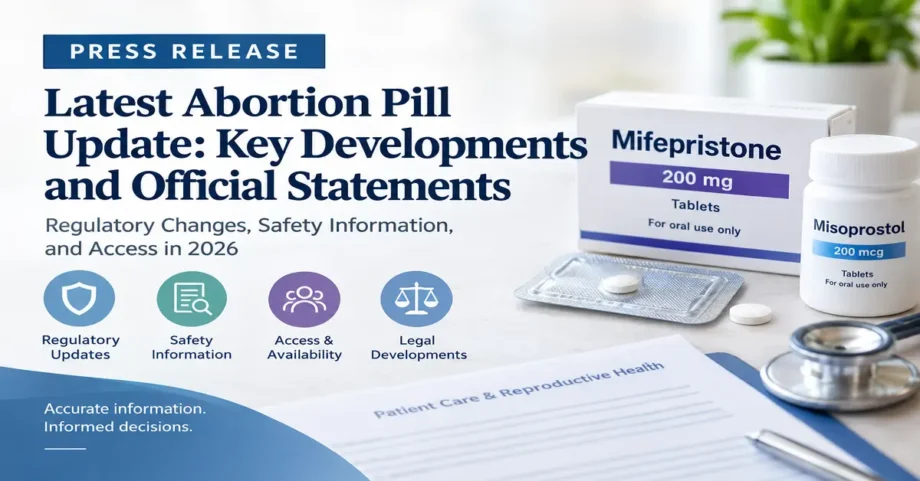
The latest developments involving abortion pills continue to draw attention from healthcare professionals, regulators, lawmakers, and the public. In the United States, medication abortion remains an important part of reproductive healthcare, while ongoing regulatory reviews, court proceedings, and legislative proposals are shaping discussions about how these medicines may be prescribed and accessed.
The latest updates focus primarily on Mifepristone, a medication used alongside Misoprostol to end an early pregnancy. Federal drug regulations, telehealth prescribing policies, pharmacy distribution requirements, and legal challenges have become central issues in the debate surrounding medication abortion
According to the U.S. Food and Drug Administration (FDA), Mifepristone is approved for use with Misoprostol to terminate an intrauterine pregnancy through 70 days of gestation. The agency continues to monitor safety information associated with the medication.
This press release provides an overview of the regulatory landscape, medical safety information, access considerations, and potential implications of ongoing developments. Because court orders and regulatory policies can change, readers should consult official government announcements and current legal guidance before making decisions based on a particular update.
Understanding the Abortion Pill
The term abortion pill commonly refers to a medication-based approach to ending an early pregnancy. In the United States, the standard FDA-approved regimen uses two medicines: Mifepristone and Misoprostol pill.
Although the medications are used together in the approved regimen, each has a different function. Understanding these differences helps readers interpret news reports and official statements more accurately.
What Is Mifepristone?
Mifepristone blocks progesterone, a hormone necessary for a pregnancy to continue. By interfering with progesterone’s action, the medicine helps prepare the uterus for the next stage of the treatment process.
The FDA first approved Mifeprex, a brand-name version of Mifepristone, in September 2000. The approved use was expanded in 2016 to cover pregnancies through 10 weeks, or 70 days, of gestation. The FDA subsequently approved a generic version in 2019.
Mifepristone Abortion Pill is subject to specific safety and distribution requirements under the FDA’s Risk Evaluation and Mitigation Strategy (REMS) program. These requirements are designed to address identified risks associated with the medication.
How Misoprostol Works?
Misoprostol abortion pill is the second medication in the FDA-approved regimen. It causes the uterus to contract, helping the body expel the pregnancy tissue.
Under the FDA-approved regimen, Misoprostol tablet is taken after Mifepristone pill according to the prescribed schedule. Follow-up with a healthcare professional is important to confirm that the process is complete and to identify any complications that may require treatment.
These medicines have different roles, and the treatment is not appropriate for every medical situation. A qualified healthcare professional can explain eligibility, contraindications, expected effects, and follow-up requirements.
Why the Latest Abortion Pill Update Matters?
Updates concerning abortion medication can affect several areas of healthcare, including the availability of appointments, prescribing practices, pharmacy services, and the ability of patients to obtain treatment remotely.
Changes to federal rules may influence how medication is distributed across the country. At the same time, state laws can affect the practical availability of abortion care, particularly in jurisdictions that impose significant restrictions.
For patients, healthcare providers, and pharmacies, uncertainty about the legal framework can create practical challenges. Providers may need to monitor changing requirements, while patients may encounter differences in available services depending on their location.
The issue also has implications for public health. Clear, accurate information about approved uses, possible complications, and access requirements helps people distinguish verified regulatory changes from speculation or politically motivated claims.
Latest Regulatory Developments in 2026
As of October 16, 2026, the principal issues surrounding Mifepristone include federal safety oversight, ongoing litigation, and the rules governing remote prescribing and distribution.
Recent reporting indicates that the FDA has been reviewing the regulatory framework for Mifepristone, while litigation has challenged aspects of the rules that permit telehealth prescribing and mail-order access. These developments do not automatically mean that the drug’s approval has been withdrawn or that every existing access route has ended.
It is important to distinguish among three separate matters:
- Drug approval: Whether the FDA authorizes a medicine for a particular use.
- Distribution requirements: The conditions under which the medicine may be prescribed, dispensed, or delivered.
- State abortion laws: The restrictions or protections that apply in individual jurisdictions.
A development affecting one category does not necessarily change the others immediately.
The Role of the FDA
The FDA evaluates medicines for safety and effectiveness and establishes conditions for approved use. It also reviews post-approval safety reports and may revise prescribing information or regulatory requirements when warranted.
In its published questions and answers on Mifepristone, the FDA states that its reviews of postmarketing data through December 31, 2024, had not identified new safety signals. The agency also explains that reported adverse events must be assessed carefully because other medications, medical conditions, treatments, and incomplete information may affect whether an event can be attributed to a particular drug.
That distinction is important when interpreting headlines about safety investigations. A review is a process for evaluating evidence; it is not, by itself, proof that a medication is unsafe or that a regulatory decision has already been made.
Prescription, Distribution, and Access Policies
The FDA’s Mifepristone REMS program establishes specific requirements for the medication. Changes to this framework can affect healthcare providers, certified pharmacies, and the process through which patients obtain prescriptions.
In 2023, the FDA revised its requirements to permit certified pharmacies to dispense Mifepristone under the applicable program requirements. This change helped establish a framework for prescription access that did not depend exclusively on traditional in-person dispensing. Subsequent legal challenges have placed aspects of that framework under scrutiny.
Patients should not assume that a news report about a proposed rule, court order, or regulatory review necessarily describes the requirements currently applicable to them. The effective status of a policy depends on the wording of the relevant agency action and any court orders governing it.
FDA Safety Review Expected to Continue Into 2027
One of the most significant recent developments was reported on October 8, 2026, when the FDA indicated that its ongoing Mifepristone safety review would extend into 2027.
According to a court filing reported by Reuters, the agency expects to receive study results by mid-December 2026 and complete its review and report by March 2027. The review could inform future decisions about the medication’s prescribing and distribution requirements. However, no future regulatory change should be treated as final until the agency formally announces it.
The review is taking place amid legal challenges to the FDA’s existing rules. Its findings could influence whether the agency maintains the current framework, changes certain requirements, or considers further regulatory action.
For now, the important distinction is between a review that remains underway and a completed decision. The announced timeline does not, by itself, mean that the FDA has revoked Mifepristone’s approval.
What Recent Legal Developments Mean
Legal disputes over Mifepristone involve questions about federal regulatory authority, state abortion restrictions, and the rules governing access to medication.
One prominent case, Louisiana v. FDA, challenges federal policies permitting Mifepristone to be prescribed remotely and dispensed through pharmacies and mail-order services. In May 2026, a federal appeals court issued a ruling that threatened those access routes. The U.S. Supreme Court subsequently paused the effect of that ruling, preserving access while the litigation continued.
The case returned to the spotlight in September 2026, when the Fifth Circuit Court of Appeals heard further arguments. The dispute remains consequential because a future ruling could affect patients and providers beyond the states involved in the original challenge.
Will the Abortion Pill Be Banned Nationwide?
A nationwide ban should not be inferred from the existence of litigation or an ongoing safety review.
Several legal questions remain distinct: whether the FDA’s distribution rules are lawful, whether specific state restrictions can be enforced, and whether federal regulators should modify the medicine’s conditions of use.
Any significant change would depend on formal agency action, applicable court orders, and potentially further appeals. Until those developments occur, headlines predicting a definitive nationwide outcome should be read cautiously.
How Court Decisions May Affect Patients
Court decisions can affect practical access even when a medication retains its FDA approval. For example, reinstating an in-person dispensing requirement could change how patients obtain prescriptions and increase the need for clinic appointments.
Conversely, maintaining remote prescribing and pharmacy distribution may preserve options for people who live far from healthcare facilities or have difficulty traveling.
The effect of a particular ruling depends on its precise terms, effective date, and any subsequent stay or appeal. Patients and providers should therefore consult current legal and clinical guidance rather than rely solely on summaries of earlier decisions.
Medical Evidence and Safety Information
The FDA’s established prescribing information remains an important reference for understanding Mifepristone’s benefits, risks, and approved use.
The medicine is approved for use with Misoprostol through 70 days of gestation. The FDA’s published information states that its review of postmarketing reports through the end of 2024 did not identify new safety signals. This finding does not mean that complications never occur; rather, it reflects the agency’s assessment of the available safety information at that time.
As the latest safety review proceeds, the public should distinguish established medical guidance from claims that have not been substantiated by the agency or reliable clinical evidence.
Common Side Effects
People using the approved medication regimen may experience several expected effects, including:
- Abdominal cramping and uterine contractions.
- Vaginal bleeding, which may be heavier than a typical menstrual period.
- Nausea or vomiting.
- Diarrhea.
- Headache, dizziness, or chills.
The severity and duration of symptoms vary. A healthcare professional can explain what to expect, how to manage discomfort, and when additional assessment may be necessary.
Serious Symptoms That Require Medical Attention
Although serious complications are uncommon, they can occur. The FDA’s prescribing information highlights the risks of severe bleeding and serious infection.
Prompt medical assessment is important if someone experiences prolonged heavy bleeding, severe or persistent abdominal pain, fainting, sustained fever, or significant weakness or illness that continues after treatment. These symptoms may require urgent evaluation, and a person should not delay seeking care while trying to determine the cause independently.
Mifepristone does not treat an ectopic pregnancy, in which a pregnancy develops outside the uterus. Suspected or confirmed ectopic pregnancy is a contraindication to the approved regimen, making appropriate clinical assessment particularly important when warning symptoms are present.
Access to Medication Abortion in the United States
Access varies according to state law, healthcare availability, and the applicable federal regulatory framework. Some states protect abortion access, while others impose restrictions or prohibitions that can significantly limit available services.
Federal approval of a medication does not automatically guarantee that every patient can obtain it in every state. State laws, court orders, provider availability, and other legal requirements may affect how services are delivered.
For people seeking information, reliable starting points include official state health resources, licensed healthcare providers, and current guidance from recognized reproductive healthcare organizations. Because the legal environment can change, checking the latest information is especially important before arranging care.
Telehealth and Mail-Order Availability
Telehealth has become an important part of the medication abortion landscape. The FDA’s 2023 changes permitted certified pharmacies to dispense Mifepristone under the applicable REMS requirements without requiring every dispensing transaction to take place in person. Subsequent court challenges have placed this policy under continued scrutiny.
As of the latest reported developments in October 2026, the Supreme Court’s pause on the Fifth Circuit ruling has preserved the existing access framework while litigation continues. That status should not be interpreted as a permanent resolution of the legal dispute.
Availability through a telehealth provider or mail-order pharmacy can also depend on the patient’s location and the provider’s ability to comply with applicable laws. Anyone considering these services should verify current eligibility, licensing, and delivery requirements with a qualified provider.
Perspectives From Healthcare Providers and Regulators
Healthcare providers generally need clear, consistent information to counsel patients about medication use, risks, and follow-up care. Changes in regulations or court orders can create additional administrative work and uncertainty about how services may be provided.
Regulators, meanwhile, must evaluate evidence, apply relevant legal standards, and explain the reasoning behind their decisions. The FDA’s current review places renewed attention on the relationship between drug safety data and distribution requirements.
Stakeholders disagree about what the review should ultimately produce. Supporters of tighter restrictions argue that the agency should reassess safety and oversight. Advocates for maintaining access emphasize the FDA’s previous safety assessments and the potential consequences of additional barriers to care.
A neutral assessment should distinguish these policy positions from established facts. The review’s eventual findings, the FDA’s formal response, and the outcome of ongoing litigation will provide more concrete information than predictions about what regulators or courts might do.
Public Health Implications of the Latest Update
The latest developments could influence healthcare delivery in several ways.
First, changes to dispensing requirements may affect how easily patients can obtain appointments and prescriptions. Second, uncertainty about legal obligations may affect the services that clinics, pharmacies, and telehealth providers are prepared to offer. Third, the outcome of the FDA review could shape future discussions about medication safety and regulatory oversight.
Clear communication will be important throughout this process. Patients need accurate information about available services and potential medical risks, while healthcare professionals need reliable guidance on current requirements.
Public discussion should also recognize that regulatory decisions involve several separate considerations: scientific evidence, clinical practice, statutory authority, and the practical consequences of different policies. No single headline captures all of these issues.
Official Information and Next Steps
Readers seeking verified updates should prioritize the following sources:
- U.S. Food and Drug Administration: Official prescribing information, safety communications, and regulatory announcements.
- U.S. Supreme Court: Order abortion pill and opinions concerning the legal status of Mifepristone access.
- U.S. Courts of Appeals: Filings and decisions in ongoing litigation, including Louisiana v. FDA.
- State health authorities and licensed healthcare providers: Information about local access, applicable rules, and medical care.
The FDA’s official Mifepristone questions and answers provide a useful reference for approved use and safety information.
For legal developments, readers should consult the actual court order or agency filing whenever possible. This helps prevent confusion between a proposed change, a temporary judicial order, and a final decision.
Conclusion: What to Expect From the Latest Abortion Pill Update
The latest abortion pill update highlights continuing regulatory scrutiny, ongoing court challenges, and uncertainty about the future of medication abortion access in the United States. The FDA’s safety review is expected to continue into 2027, with a report anticipated by March, while legal proceedings continue to examine rules governing remote prescribing and mail order abortion pill distribution.
At present, the latest reported developments do not establish that Mifepristone’s FDA approval has been withdrawn. The existing access framework remains in place while key legal disputes proceed, although future regulatory or judicial decisions could change the situation.
For patients, healthcare providers, and the wider public, the most reliable approach is to follow official announcements, review current medical guidance, and distinguish confirmed decisions from proposed changes. Further clarity is expected as the FDA completes its review and the courts consider the remaining legal questions.
Frequently Asked Questions (FAQs)
The FDA has indicated that its Mifepristone safety review will continue into 2027. The agency expects to receive study results by mid-December 2026 and complete its report by March 2027. Meanwhile, litigation concerning telehealth prescribing and mail-order abortion pill distribution continues.
The latest reported developments do not indicate that the FDA has withdrawn Mifepristone’s approval. The agency is reviewing safety information, but a review does not automatically constitute a ban or a change in approval status.
As of the latest reported updates in October 2026, the Supreme Court’s pause on a lower-court ruling has preserved the existing federal access framework while litigation continues. Actual availability may depend on applicable state laws and provider policies.
The FDA has previously determined that Mifepristone is safe and effective for its approved use when used according to the applicable prescribing requirements. However, like other medicines, it carries risks, including bleeding and rare serious complications. The FDA continues to monitor safety information.
The FDA expects to complete its current safety review by March 2027. Additional developments may occur sooner through court rulings, regulatory announcements, or new filings. The timing and substance of any future policy changes remain uncertain.